

True Belonging Is A More Primal Need Than Food!
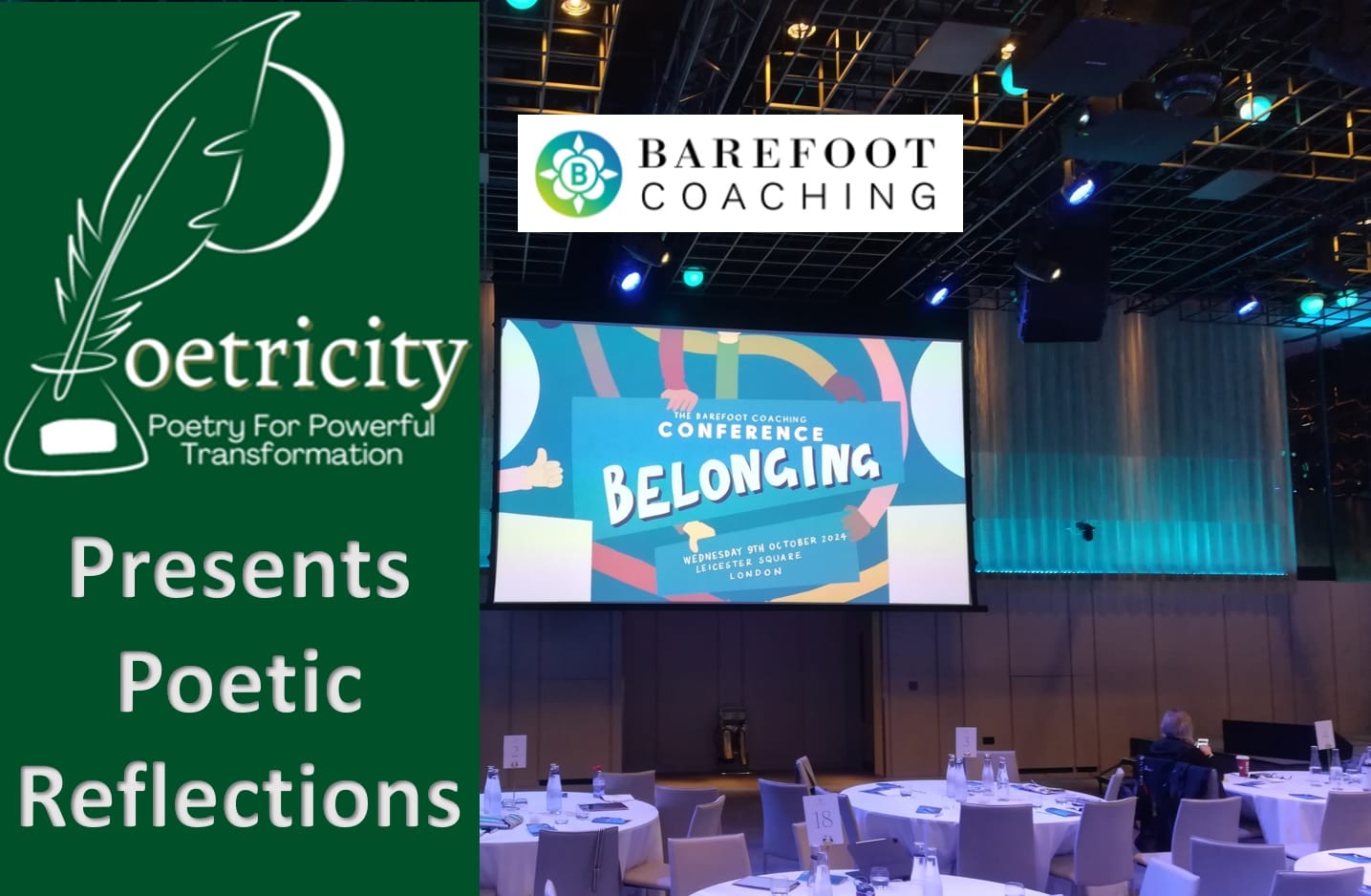
This is just one of the gems from the Barefoot Conference of 2024 held yesterday in London. The first in five years!
It was one of the best conferences I have ever been to. My heart is full and so is a good section of my journal.
The theme was belonging and that was exactly what I experienced as I learned from the various speakers, and interacted with fellow barefooters.
Emma Jones, John Perry, Andy Chandler PCC, James Sills, Bernice Hewson MA., BSc. and Owen Eastwood did a fantastic job of invoking such deep reflection in us as coaches as to how best we can serve our clients by creating an environment where belonging is a given.
Kim Morgan MCC, you are a true legend! Thanks for following your heart to create this family of coaches facilitating transformation in the world.
Thanks to everyone on the Barefoot staff, your attention to detail paid off!
I have a lot to share about the day so watch out for more poetic reflections.
Here is a piece on belonging that sets the scene. Enjoy and share in the comments what your experience of belonging is.
Barefoot Belonging
By Frank Bolaji Irawo
London City was the place
To dispense of air and graces
No need to ring the changes
To pretend your face fits in
One by one it was assembled
As heart-to-heart joined together
Embracing our shared humanity
While respecting our preferences
Basking in the history
That was about Kim's story
A vision becoming a reality
Coaching to be taken seriously
Training is just the start of it
From there arose a family
As varied as the eye can see
Celebrating all genders and races
Awash with bare laughter, hugs and stories
A conference walking the talking
In the wonderful outpouring
Of true Barefoot belonging
Jackee Holder - Thanks for the gifts, much appreciated
Vivian Eni - Thanks for the burst of energy, photos and your autographed book
To those of you, I met in the flesh, thanks for your time, hugs and well wishes.
Lucy Chaplin PCC, Rebecca Beck (FCIPD) PCC, John Anderson MBE, Carolyn Hawley (PCC, FCIPD), Mark Drax, Rachel Varrilly Gierula PCC, Tim Johnston, PCC, Kelly Wood, Annie Lee, Sandra Whiles (She/Her), Chaya Mistry, Pete Mosley, Ted Bradshaw, Andy Bragg, @Jon McNestrie, Dom Burch
In this series, I will be musing over some of the words and ideas that captured my attention and present my take on them. I invoke reflection on what that means for us as coaches and for our clients.
None of us is as smart as all of us, so I encourage you to engage in the comments section with your responses, adds or contra views. It all helps to make a richer pool of inspiration.
In Kim Morgan MCC's introduction to the conference, she talked about how her parents changed aspects of themselves to fit into their social dynamics. This in turn created identity confusion for her.
If you have to change who you are to be accepted, will you ever belong?
Changing yourself in exchange for acceptance requires you to disown yourself.
You sacrifice belonging to yourself in the hope of belonging to a group of others.
If you no longer belong to yourself, you dissipate the energy of who you are and how you show up as a leader.
If people are inclined to accept a modified version of yourself, who are they accepting?
How long can you keep this up for and at what cost to your joy and fulfilment?
Belonging is a primal need which means that it operates at a subconscious level, it has often kicked in by the time we catch it. Awareness is our friend and a NEWWAY of responding.
[N]oticing how I am experiencing people without judgement
[E]nquiring what is going on for me that informs my responses
[W]ork out which belief systems drive that response
[W]onder what other belief system could be true
[A]lter my response based on an updated belief that could
[Y]ield a different outcome and then repeat
********
PEGs are Calling
By Frank Bolaji Irawo
PEGs are Calling
By Frank Bolaji Irawo
Calling all those square pegs trying to fit in round holes
Ever considered that there is a square hole for you?
Yes, you could keep shaving away at those edges
Losing the distinctions that make you unique
All just so that you can fit in a hole made for another
What happens then to those, to whom you were sent?
Eagled eyed, waiting for one shaped just like them
While they sit and wait, watching you shave away
The subtle message received, that edges are not the way
Leave the round pegs to the round holes, to it they are called
Keep being the best you know to be, in the hole made for you
Grant others the permission to embrace their uniqueness
There lies your super power my friend, energy unbridled
Sending out that unmistakable clarion call
Your tribe is here and waiting to cheer you on…
********
Share in the comments section below your response to the below:
As Coaches: What can you do if you catch yourself second-guessing your approach out of concern for how the client may perceive you?
Our Clients: How can we help our clients reclaim their true identity, if we perceive that they are rejecting parts of themselves?
********
Part 1 in this series deals with acceptance and belonging (link in comments below).
Here we focus on John Perry's session about attachment and its impact on our sense of belonging.
There is a window of opportunity in a child's early development to shape their worldview through the relationship they have with their primary caregiver.
The unspoken question from the child is, will their caregiver be a consistent reassuring presence?
If yes, then they learn:
✨I am worth someone's attention and people can be trusted to be there for me
✨The world is a safe place and there is a license for adventure
✨I am secure and so can relax, be more optimistic and creative
If not, then they learn:
✨I am not worth someone's attention and people can't be trusted to be there for me
✨The world is an unsafe place and adventure is an unnecessary risk
✨I am insecure and can never relax, pessimism is safer and creativity is a luxury
We go through life conditioned at an early age without getting the programming upgraded to reflect our increased capacity to look after ourselves.
Born to Nigerian parents in 1960s UK. The reality of the job market in those days required them to leave me with a nanny all week to be collected at the weekend.
Imagine the sense of abandonment that young version of me must have felt. The impact is real even when there is no intent by our carers.
I often developed high temperatures, which miraculously disappeared when I was at the doctor's.
This cycle changed once they found a nanny who had a son about my age I could play with.
As a coach, I had to work through the need to save my clients and as a client work through pleasing people at my expense to belong.
The kind of attachment coaches and our clients experienced in our early years is likely to show up in the coaching relationship.
Learning more about this would help us know when to provide reassurance or dial back blind trust.
********
A is for...
By Frank Bolaji Irawo
A is for attachment
to the one who cares
On it my survival depends
Special uniqueness that I am
Of it, I cannot be bereft
A is for Attunement
Resonating with another
I see you, you see me
My need to connect
None is an island
A is for Authenticity
For me to stand tall as me
To have that say in that voice
So uniquely mine
Staying true rightly or wrongly
A is for Abandonment
The risk I take in Authenticity
Navigating attachment
Seeking to be attuned
To whoever is available
A is for Autonomy
Self-love, trust in the universe
I breathe and rescue my Authenticity
Alienated from it, I am drained
In Autonomy my power is restored
*******
Share in the comments below your thoughts on this:
As Coaches: How is the experience of attachment showing up in how you coach?
Our Clients: What can you do to support clients who may be experiencing insecurity as a result of poor attachment?
*******
Part 2 in this series focused on John Perry's session on attachment (link in comments below). Here we focus on Andy Chandler PCC's session on the systemic view of belonging and leaving gracefully.
"Systems thinking is a holistic approach to analysis that focuses on the way different parts of a system interact and how they influence one another within a whole," - Dr. Jennifer Teague
The premise is that as we traverse the human lifecycle from birth to death we are constantly in the process of joining, belonging and leaving several systems.
Mine include family, education, professional, spiritual, social and cultural systems. How much of who I am today has been shaped by interacting with the people who make up these systems.
When we join a system and experience a sense of belonging, leaving can be difficult. I recently decided to leave a coaching community I was a part of as they were moving to a different platform.
My mind kept trying to make someone wrong for what was happening.
I remained centred as the witness of all the thinking and recognised that this was a natural point for the end of a journey that had contributed to my growth as a person and coach for over 2 years.
I reflect on the three systemic principles that Andy shared and how they relate to how I reframed my thinking to leave the community gracefully:
Time - I acknowledged that I had been allowed to be a part of the community's history, acknowledging those who had come before and those I was leaving behind.
Place - I recognised the contributions of those who had come before me, which laid the foundation for me to experience belonging in the community.
Exchange - I celebrated that I had received so much support from the group to embrace every part of me and express the full breadth of my gifts and I had in return served those gifts back to them as we all grew together.
Nobody was wrong, it was just time to move on.
I may not be there every week anymore but they will always be with me. The impact that they have had on me is irreversible.
If my relationship with the Barefoot community is anything to go by, I'll be there at any opportunity for a reunion!
********
Sour memories
By Frank Bolaji Irawo
We used to be tight
Spending time together
That felt just right
Exchanging chatter
Bonding together
Part of each other's stories
Those are our memories
I ruminating on how
Things should be
Disappointed by
Our present apathy
That can't change
The beauty sealed
In those moments in
History
Save the mind
And its comparisons
The sure way to
Sour memories
*******
Share in the comments below your thoughts on this:
As Coaches: How do you deal with the ending of a coaching relationship that has not gone well?
Our Clients: How can we support our clients to leave relationships that no longer serve them gracefully?
*******
Part 3 in this series focused on Andy Chandler PCC's session on the systemic view of belonging and leaving gracefully (link in comments below).
This time we explore @Bernice Hewson MA., BSc.'s session about the role race plays in coaching.
"When someone really hears you without passing judgment on you...it feels damn good…” - Carl Rogers
Coaching is grounded in unconditional positive regard, which creates an environment for coachees to feel safe and not expect to experience prejudice based on their race in the coaching relationship.
You may infer that the coaching relationship should be colourblind, but as Bernice put it,
"Racial identity shouldn't matter…but race does matter"
I was a strong advocate for the colourblind approach. While there was merit to the idea of looking beyond colour to our shared humanity when interacting with people; it felt like a denial of the differences in our lived experiences where colour was concerned.
The coaching industry is predominantly white it follows that mainstream coaching practices would reflect and reinforce cultural assumptions specific to that demographic. This can have the effect of further marginalising people of other backgrounds.
The Black Lives Matter movement made race something we tiptoe around to avoid detonating any minefields and causing offence.
A 2023 study found that white coaches tend to avoid diversity-focused discussions with black clients and black leaders received less critical feedback and developmental conversations than their white counterparts, resulting in missed opportunities for growth.
We are surrounded by systems that have racial privilege built in. Racism is here and denial won't change that.
As coaches let us be willing to look within for our biases while becoming aware of external factors that influence outcomes based on race.
This will have us better prepared to have these conversations with our clients.
In the last year alone I have been told by clients of colour that my race as a coach influenced how much they felt comfortable discussing their experience of racism with me.
If we address the race elephant in the room we have a better hope of having honest conversations that move the needle.
While we are at it; let us get more people of colour into coaching and acknowledge the value their culture can bring to the profession!
********
Socialisation
By Frank Bolaji Irawo
There is a process
A systemic process
One that keeps working
With or without your permission
Shaping your identity when you're asleep
That's the process referred to as socialisation
*******
Share in the comments below your thoughts on this:
As Coaches: What has been your experience of race in a coaching relationship with a client?
Our Clients: if you suspect your clients are operating under a racist system, how would you broach the matter?
*******
In part 4 of this series, we explored Bernice Hewson MA., BSc.'s session about the role race plays in coaching (link in comments below).
James Sills's session demonstrated how masterful leadership creates belonging and makes the whole greater than the sum of its parts.
"The...did not people the earth with a vibrant orchestra of personalities only to value the piccolos of the world. Every instrument is precious and adds to the complex beauty of the symphony." - Joseph B. Wirthlin
How do you get a room of about 250 people of varying singing prowess to give a wonderful rendition of "Your Love Keeps Lifting Me..." By Jackie Wilson in 30 minutes?
That is exactly what James did through masterful leadership. By creating a sense of belonging and belief in this untested choir.
James's mastery of his craft was self-evident in how he guided us into teams, assigned us parts and put us all through our paces and our incredulity at how all those strange sounds combined resulted in such a beautiful symphony.
He led us by:
✨Presenting the vision
✨Organising us into teams
✨Making it feel achievable
✨Coordinating the execution
✨Celebrating our achievement
In working on the song project we experienced belonging:
✨Each person in the room had a part to play – we could not do it without them
✨Not everyone's part was the same – it takes different melodies to make a harmony
✨Each part was needed - the significance of every part was explicit, not relative
To complete the process, we needed to:
✨Trust in ourselves we could do it - regardless of previous singing experience
✨Trust in the process - we couldn't always see how what we were doing would turn out once combined
✨Trust in James's leadership - that he knows what he is doing
It was a partnership that drew out the best in us, helping us achieve more than we could have individually.
I am reminded of a coaching partnership. Can you see that?
Trust In Residence
By Frank Bolaji Irawo
Tearing through the rooms
Worry ruled the roost
Perturbing all things
Steeped in tall tales
How all could fail
Till it came across trust
Making it quite clear
The house was secure
Peace now restored
Worry having subsided
With trust in residence
*******
Share in the comments below your thoughts on this:
As Coaches: How are we showing up with our clients to help them achieve more than they thought was possible?
Our Clients: How can you tell if enough trust collateral has been built to invite them to stretch beyond their comfort zone?
*******
In part 5 of this series, James Sills 🎤's session showed how great leadership makes the whole greater than the sum of its parts.
In the last session, @Owen Eastwood's session wonderfully consolidated the theme of belonging through his story and lifelong work at the top level of elite sports.
"When you start about family, about lineage and ancestry, you are talking about every person on earth" - Alex Haley
Owen gained a sense of belonging when he heard an origin story about a female ancestor known for her courage.
Stories have been used since ancient times to unite people and create a cultural sense of belonging.
In contrast to Western focus on the individual, native culture helped Owen see himself as part of a rich heritage of people and that it was his turn to embody their empowering values and a custodian to pass them to future generations.
This resonates with the systems perspective presented by Andy Chandler PCC and the value in honouring those who had gone before and laying the foundation for those to come.
Working with elite teams tasked with delivering great sporting outcomes, Owen leverages the impact of the members belonging to something bigger than themselves:
They unite together under a:
✨Shared heritage - What has been entrusted to us by those who have gone before?
✨Shared vision - What are we committed to achieving now?
✨Shared values - What is different about how we want to achieve our vision?
In Kim's introduction, we were reminded that belonging does not require you to abandon your identity.
As Owen put it, once you know what you are a part of, the Sun of responsibility is now on you. Be yourself and bring your best in service of the team:
✨How can you embody the shared heritage in a way that is authentic to you?
✨ What is your part in helping the team achieve the shared vision?
✨How in your day-to-day are you living out the shared values?
Getting the best out of the team requires honouring the team while acknowledging each person's individuality.
This is achieved by :
✨Including every voice in shaping the vision
✨Getting consensus on how the environment can be shaped to help them be at their best
✨Agreeing up front on what is sacred to everyone and where individuals are free to play
This creates a powerful context for the contracting process in a coaching partnership.
*******
I am here
By Frank Bolaji Irawo
I am here
Not here on my own
There were those before
I am grateful for the lives they lived
The choices they made
Making it possible for me to be here
Here to make a difference
Here to make a change
Here to write a different story
That the end may be a better beginning
For those here after me
*******
As Coaches: How are we considering the impact the system within which our clients operate has on them?
Our Clients: How can we help them build awareness of how their choices impact those that will come after them?
*******
As a TransFLOWmation coach, I help entrepreneurs and business leaders remove mental blockers, unleash dormant creative energy and fearless innovation, and rejuvenate their business relationships to ignite and increase productivity.
TransFLOWmation is based on the following premise: We have infinite potential residing within
For us to maximise that potential, we need to let it FLOW from within aligned and unhindered.
This is achieved using a suite of services based on the following high-level outline of the 4 Pillars of Professional TransFLOWmation.
These four pillars are the key to experiencing it.
Clear: Remove the mental blockages stopping you from recognising your potential
Connect: Connect to and align with your true purpose
Collaborate: Work with the universe and those it puts into your life
Create: Start to fulfil your potential by taking inspired action
It is a 4-stage/16-module instructional guide process that can be highly customized to meet personal needs to get the universe “flowing” in your favour, maximising your professional potential.
Click Below for A high-level outline of my Signature Program. I look forward to discussing it further!
Conversations to Ascend Living Miserably by creating Space to Embrace Life Fully
© 2023 | Systeme.io

